
Climate & Care Initiative Fund
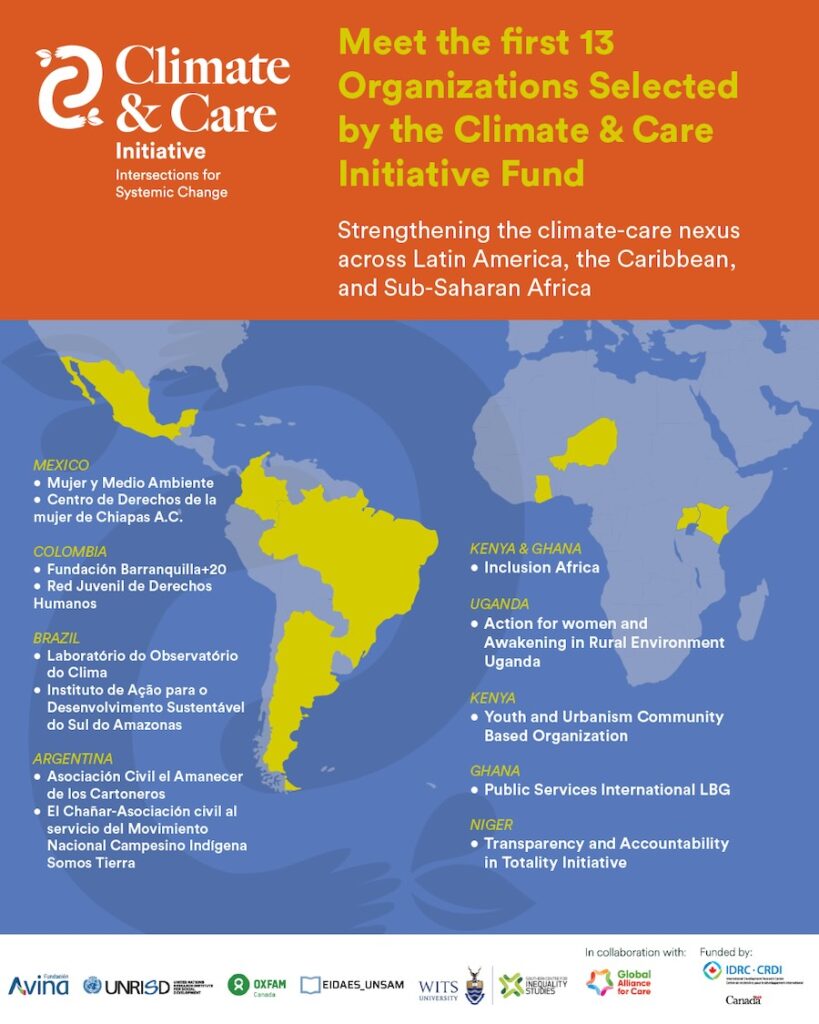
The Fund was part of the Climate and Care Initiative, supported by the International Development Research Centre (IDRC) and led by a consortium comprising the United Nations Research Institute for Social Development (UNRISD), Oxfam Canada, the Southern Centre for Inequality Studies (SCIS) at Wits University, Universidad de San Martín and Fundación Avina, in collaboration with the Global Alliance for Care. ,The Fund received more than 1,200 applications from grassroots organizations, NGOs, and social movements across Latin America and Sub-Saharan Africa. This strong participation reflects the increasing recognition of the climate-care connection and the need for dedicated funding and policy solutions at this intersection.
About the Fund
The supported projects explored how climate change increases and reshapes care needs, while demonstrating ways to redistribute care more equitably, strengthen community resilience, and integrate care into climate adaptation and mitigation strategies.
Fund at glance
The projects addressed areas including:
Explore the projects and their lessons
Each project showcases practical solutions that address the challenges at the intersection of climate change and care work.
Mujer y Medio Ambiente, A.C.

Territories in Transformation: Contributions from Rural and Urban Communities to Connect Climate Change and Care
The project places the climate-care nexus on local agendas by making visible the mitigation and adaptation efforts of community organizations and their impact on the care work of women, girls, and other disadvantaged groups. It strengthens organizational, technical, and planning capacities so women and men can design sustainable, inclusive actions and advance toward care redistribution. Centering a gender-equal and intersectional approach, the initiative highlights women’s role as agents of change for climate justice and for overcoming the gender subsidy that limits their full participation.
Website: https://www.mmambiente.org/
Social media:
Inclusion Africa (IA)
Adaptive Futures: Climate and Care for People with Intellectual Disabilities in Africa
This project addresses the disproportionate impacts of climate change on people with intellectual disabilities in Africa, who are often excluded from adaptation efforts. It highlights the root causes that include stigma, the absence of inclusive policies, and limited support systems and infrastructure. Working with highly vulnerable and marginalized communities, the initiative promotes inclusive disaster preparedness and greater participation from climate shocks such as floods, droughts, and extreme heat.
Website: http://inclusion-africa.org/
Social media:

Fundación Barranquilla+20
Women Caregivers for Life and Climate Justice in Colombia and Abya Yala
This initiative brings together 100 young women, elders, and territorial defenders to position care as essential for well-being and climate resilience. Led by women from diverse ecosystems and ethnic communities, it strengthens the climate-care link across local, national, and global levels. The project promotes advocacy within Colombia’s climate system (SISCLIMA) and NDCs, integrating care into national climate and care strategies. It includes a Regional Diploma in Feminist Eco-Care, participation at COP30, and a report for the UNFCCC Gender and Climate Action Plan—framing care as green work and a key pathway to climate justice.
Website: https://barranquillamas20.com
Social media:

Red Juvenil de Derechos Humanos
Community Action for Resilience, Equality and Sustainability (CARES)
Implemented in Nariño, Colombia, CARES focuses on young Indigenous women facing intersecting vulnerabilities linked to climate change and gender inequality. The project aims to enhance climate resilience and gender equity through integrated strategies that redistribute care work and strengthen community adaptation capacities. By embedding care and gender perspectives into climate mitigation and vulnerability reduction efforts, CARES addresses systemic barriers limiting Indigenous women’s participation and economic opportunities. Its overarching goal is to transform local disaster management by building a collaborative ecosystem where young Indigenous women become central decision-makers in driving sustainable and inclusive community responses.
Website: https://www.redjdh.org
Social media:

Asociación Civil el Amanecer de los Cartoneros
Between Caring and Recycling: Women, Children, and the Climate Challenge
This project supports five childcare centers in waste-picking communities across Córdoba, Corrientes, Chubut, Buenos Aires, and Capital Federal. These centers will provide 175 children with meals, health monitoring, and educational and recreational activities, enabling their mothers—women waste pickers—to access better economic opportunities. Additionally, 95 women will receive training in labor rights and community management, promoting autonomy and improved working conditions. The initiative integrates care, climate, and labor justice, and is grounded in partnerships with cooperatives and municipalities to ensure long-term sustainability and impact.
Website: http://acamanecer.org.ar
Centro de Derechos de la Mujer de Chiapas A.C.
Care and Sustainability: Redistributing Care Work and Protecting the Environment in Tseltal and Ch’ol Indigenous Territories
This project strengthens the political participation of Indigenous Tseltal and Ch’ol women in the Selva region of Chiapas, Mexico. It challenges patriarchal structures that limit their access to land and resources by promoting their involvement in community and ejido assembly decision-making spaces. By connecting care work with environmental protection, the initiative promotes a more equitable redistribution of responsibilities and fosters sustainability through Indigenous women’s leadership in the defense of their territories.
Social media:

AWARE Uganda
Improving Care Work Affected by Climate Change Impacts in Kaabong, Karamoja Region
This project works in communities in the Kakamar and Lolelia subcounties of Kaabong, Uganda, where climate change intensifies the unpaid care and domestic workloads. Working with 10 women’s groups, the initiative integrates climate-smart agriculture through farmer field schools, improves home care systems, and strengthens food security. It trains men and boys in caregiving roles to reduce gender-based violence, and provides entrepreneurship and VSLA training for women. The project also promotes local policy advocacy, enhances women’s mobility and autonomy, and supports women’s leadership in care and climate decision-making for long-term resilience and equity
Website: https://www.awareuganda.org
Social media:

Laboratório do Observatório do Clima
Expansion of the “Defensoras por Defensoras” Program
The “Defensoras por Defensoras” program provides a space for support and empowerment among women protecting their territories, ecosystems, communities, and the planet’s climate. These women are on the front lines of territorial protection, yet face invisibility and daily threats due to the disproportionate impacts climate change has on women, exacerbated by their dual caregiving role in society. This initiative strengthens this network, creating a space for knowledge exchange, strategy development, and supporting territorial defense. The program includes Indigenous, Black, Quilombola, rural, peripheral women, and others from territories at risk from climate change across Brazil.
Website: https://www.oc.eco.br/
Social media:

El Chañar-Asociación civil al servicio del Movimiento Nacional Campesino Indígena Somos Tierra
Recognition of the Role of Rural and Indigenous Women in Life Care and Climate Change Mitigation
The project aims to understand and analyze the gender inequalities faced by rural and Indigenous women of MNCI-ST regarding caregiving roles, with a focus on environmental sustainability and food security. They have developed educational and communication strategies that promote their visibility and empowerment in strengthening climate-resilient communities. This includes strategies to redistribute caregiving tasks, enhance the commercialization of food and goods for better valuation, and advocate for a national law recognizing the role of rural and Indigenous women in climate change mitigation and the protection of biodiversity.
Website: https://mncist.com.ar
Social media:

Youth and Urbanism Community Based Organization
Climate and Care for Her: Strengthening Resilience for Women in Urban Slums
Youth and Urbanism (Y&U) addresses the vulnerabilities of young girls and women in Kenya’s informal settlements, like Mathare, by focusing on the intersection of climate change and caregiving. The initiative gathers data to inform interventions, amplifying women’s voices in climate discussions and promoting locally-driven solutions. Y&U advocates for climate care financing and decent care as green jobs, while integrating these issues into policies and budgets. The project is sustained through programs under Climate Change and Gender Equality pillars and supported by advocacy tools, ensuring resilience, equity, and climate justice for future generations.
Website: https://youthandurbanism.org/
Social media:

Public Services International LBG
Supporting Health and Care Workers for Climate Resilience in Ghana
This project addresses the intersection of climate change and care by improving the working conditions and resilience of health and care workers in Ghana. Through an action-based learning approach, it engages workers in identifying solutions to occupational hazards worsened by climate impacts, such as extreme heat and environmental degradation. It conducts risk assessments, provides training, and advocates for better conditions and policies. The project also builds the sector’s capacity to manage climate-related health challenges like vector-borne diseases and malnutrition, ensuring workers’ voices shape climate and health policies for more equitable, sustainable, and climate-sensitive systems.
Social media:

Transparency and Accountability in Totality Initiative (TinT-FollowTaxes)
Empowering Women Care Workers in Vulnerable Communities for Climate Resilience and Adaptation in Kaduna and Taraba State
Women in rural communities in Kaduna and Taraba State face severe climate impacts, including droughts, floods, and declining crop yields. These regions also host displaced victims of farmer-herder conflicts and banditry, further straining resources and promoting unsustainable farming practices. Women in these communities bear a significant unpaid caregiving burden, managing children, the elderly, domestic tasks, and those affected by disease and displacement. Despite their crucial role in caregiving, cooking, cleaning, and supporting livelihoods, their efforts remain unrecognized and unpaid, highlighting the need for empowerment and support to enhance their resilience and adaptation to climate change.
Social media:

Instituto de Ação para o Desenvolvimento Sustentável do Sul do Amazonas – ASA
Women and Climate: Challenges and Solutions for Care and Climate Adaptation in the Legal Amazon
The project integrates gender, care, and climate dimensions into municipal public policies. It focuses on three main areas: (I) diagnosing climate impacts and care demands, proposing solutions to strengthen protection networks; (II) training women and empowering local organizations in Humaitá, increasing their participation in public decision-making through the Municipal Women’s Rights Council; and (III) creating spaces for collective discussion across different Amazon territories to share solutions and best practices related to climate adaptation and care policies. The project strengthens the correlation between climate and care policies, inspiring regional and national strategies for policy improvement and enhancing the care agenda in climate negotiations.
Vendors Initiative for Social and Economic Transformation (VISET)
Informal Economy's Action For Climate & Care Initiative (IEACCI)
This project targets women caregivers in Zimbabwe’s informal economy, including vendors, domestic workers, and waste pickers, who are disproportionately affected by climate change and care burdens. Implemented in Harare, Goromonzi, and Chiwundura, it established the Care and Climate Resilience Hubs that offer childcare, health services, and climate-adaptive training. VISET promotes sustainable livelihoods through green jobs such as recycling and agroecology while advancing policy advocacy for the recognition of unpaid care work and inclusive climate action. The initiative builds a gender-equal, climate-resilient informal economy that values both paid and unpaid contributions.
Website: www.visetonline.org
Social media:
Fundación Social Cultural
Restauración Hídrica y Resiliencia comunitaria: Microcuenca del río Cariacu
This project promotes ecological restoration and gender-responsive community resilience in northern Ecuador’s Cariacu micro-watershed. Led by Indigenous and campesino women, the initiative combines forest regeneration with native species, sustainable water management, and collective spaces for care and leadership. These guardians of the páramos strengthen local economies and food security through eco-enterprises and agroecology, linking environmental protection to women’s rights and climate justice. The project creates strategies for addressing structural violence, empowering women to lead from a place of belonging and resilience.
Social media:
Siaya Muungano Network (SIMUN)
Caring for Carers, Mobilizing Support to Build the Resilience of Rural Older Women in Climate Emergency
This initiative supports older women in Siaya County, Kenya, whose care work and health are increasingly impacted by climate change. Often overlooked in climate policies, these rural caregivers face intensifying burdens due to droughts, floods, and poor soil quality. SIMUN will provide psychosocial support, local training, and community-based strategies to enhance health, water access, and food security. The project recognizes the key role of older women in caregiving and aims to amplify their contributions and resilience within climate adaptation efforts.
Website: https://www.siayamuunganonetwork.org
Social media:
Socios en Salud
Strengthening Climate-Resilient Caregiving for Early Childhood Development in Ventanilla, Peru
This project expands CASITA, a community-based caregiving model in Ventanilla, Lima, to incorporate climate resilience and early childhood development. Socios En Salud trained former program participants as “Community Educators in Climate Resilience” to reach 100 caregivers with education on heat risks, water conservation, and disease prevention. The project also promotes shared care responsibilities through peer networks and engages local authorities to advocate for fair compensation and recognition of community caregivers. It offers a scalable model of climate adaptation rooted in equity and community leadership.
Website: https://sociosensalud.org.pe/
Social media:

Fundación Futuro Latinoamericano (FFLA)
Comunidades Kichwas por el Clima y el Cuidado
Led by the Kichwa women of Mariscal Sucre, this project strengthens climate resilience through agroecology, water harvesting, and native reforestation. Combining ancestral knowledge with technical training, it enhances care, equality, and environmental protection in the Andean highlands. The project supports intergenerational spaces for reflection, economic autonomy through sustainable livelihoods, and leadership development. It centers women’s roles as stewards of territory and well-being, embedding care within broader strategies for climate adaptation and gender justice.
Social media:

Asiye eTafuleni
Caring for Carers, Mobilizing Support to Build the Resilience of Rural Older Women in Climate Emergency
Based in Durban, AeT works closely with informal urban workers to promote inclusive urban planning and sustainable livelihoods. Informal workers, while having a low climate footprint, face extreme vulnerability to climate change impacts due to precarious housing, lack of infrastructure, and absence of social protection. This initiative trains informal workers as “Climate and Care Champions,” building on AeT’s experience with health and zero-waste champions. The project will develop context-specific training materials on the climate–care nexus and support these leaders in spreading knowledge and strengthening community-based resilience. By recognizing the vital contributions of informal workers, the project advances equity, urban inclusion, and distributed models of care in the face of growing climate pressures.
Social media:

Organisation Solidaire pour le Développement Humain Intégral (OSDHI) Caritas Bondoukou
Strengthening Care Systems and Climate Resilience in Two Rural Communities in the Bounkani Region in Northeastern Côte d’Ivoire
This project reduces care-related inequalities and enhances climate resilience in two rural communities in the Bounkani region, northeastern Côte d’Ivoire. In response to droughts, floods, and natural resource degradation, OSDHI Caritas Bondoukou implements an integrated approach that eases the burden of unpaid care work, especially for women. The initiative combines access to clean water, solar energy, sustainable agriculture, and the creation of community care networks. It also promotes women’s participation in local governance and economic empowerment while strengthening community-based natural resource management. All actions are aligned with national climate commitments and grounded in gender equality and inclusive development.
Website: https://www.caritasbondoukou.com/
Social media:
Galore Public Health Initiatives
An indigenous non-governmental organization committed to improving public health outcomes in Nigeria and across Africa
Across Benue State, evidence from 200 rural respondents is shaping climate action that integrates agriculture, health, and care. The project highlights women’s disproportionate care burdens and advances solutions—from climate-smart farming to childcare systems—to strengthen resilience and livelihoods.
Website: https://www.galore.org.ng/

Sauti Salama
They work to bridge gaps in access to care, safety, and justice for women and girls.
The project is addressing the climate–care nexus by reducing unpaid care burdens and GBV risks during climate shocks, strengthening community resilience, promoting renewable energy solutions, and enabling women’s participation in climate decision-making and care systems transformation.
Website: https://www.sautisalama.org/

Amara Hub
A “think-and-do tank” that equips under-recognized communities and emerging leaders with the knowledge, networks, and resources to thrive in a changing world.
Through this project implemented in In Northern Uganda, participatory research and community dialogue are making visible how climate stress increases unpaid care. Through photovoice, policy engagement, and a shared care pod, the project promotes collective solutions that enable caregivers to participate in climate action.
Website: https://www.amarahub.org/
Next Steps and
Future Updates
Follow this space for:
climateandcareinitiative@avina.net